
A Practical Way to Build and Maintain a Technical Debt Register
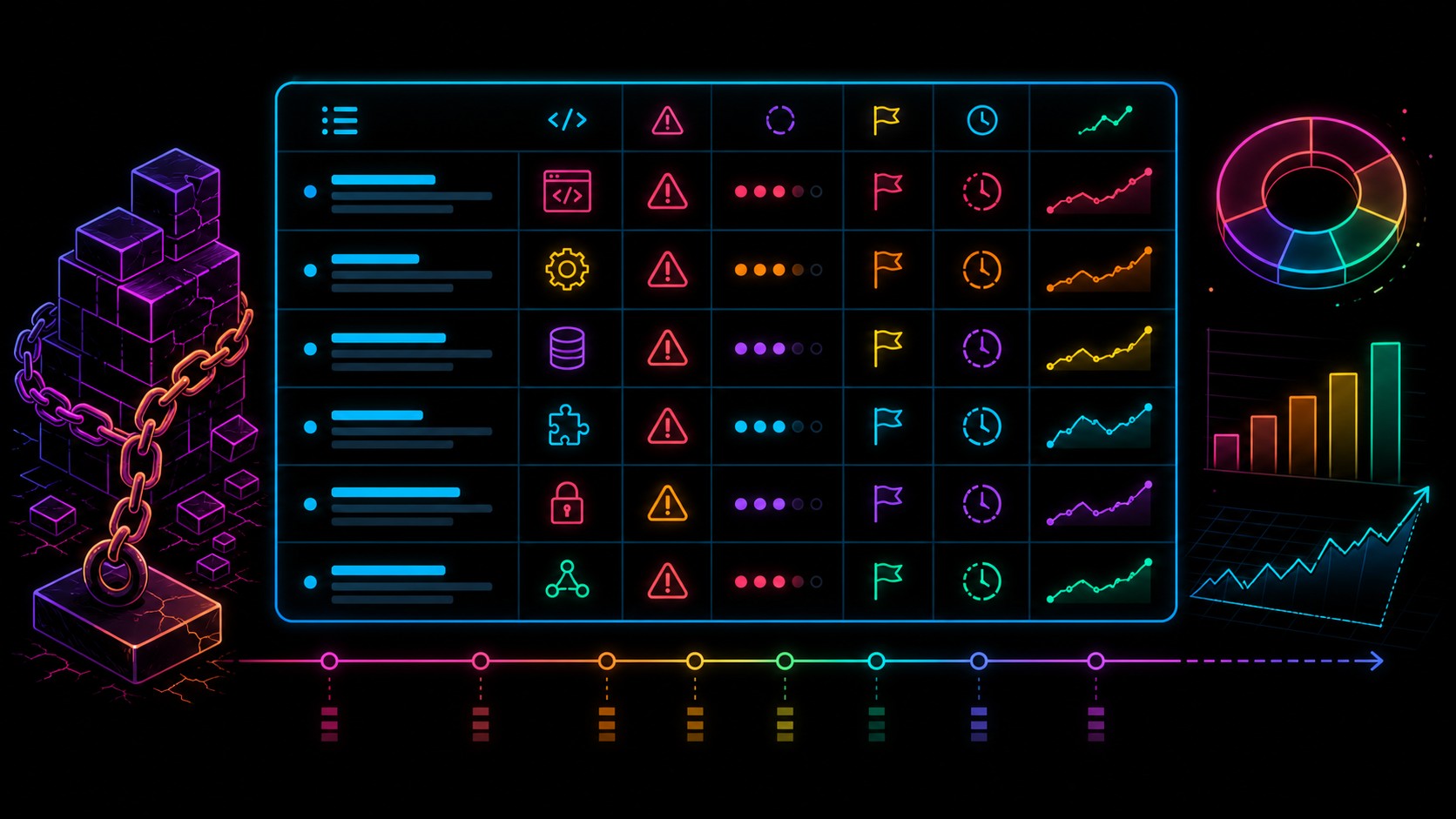
Every engineering team talks about technical debt, yet few manage it effectively. The difference between teams that steadily improve their platforms and those that slowly grind to a halt isn't the amount of technical debt they have—it's whether they maintain a living technical debt register. A good register transforms scattered frustrations into an actionable engineering backlog, helping teams make informed decisions instead of constantly reacting to the loudest problem.
Many organisations mistakenly treat technical debt as anything developers don't like. That approach quickly produces an overwhelming list of vague complaints that nobody ever reviews. A useful technical debt register is different. Every item should describe a specific problem, explain why it matters and identify the business impact. If the only justification is "this code is ugly", it probably doesn't belong in the register.
Technical debt exists because software changes faster than architecture. Features are delivered under deadlines, integrations evolve, platforms age and business priorities shift. Over time, shortcuts accumulate. Duplicate business logic appears across services, configuration becomes inconsistent, legacy components remain because replacing them is risky and documentation falls behind reality. None of these decisions are necessarily wrong when they are made, but together they increase the cost of every future change.
The first step in building a useful register is choosing consistent information for every entry. Record the affected system, a concise description of the issue, the business risk, the technical consequence, the estimated effort to resolve it and the expected benefit. Assign an owner and review date so the item remains visible. A register without ownership quickly becomes a forgotten spreadsheet.
Not all technical debt deserves immediate attention. Prioritisation should consider frequency, operational risk and future impact. Ask simple questions: Does this slow every feature? Does it create production incidents? Does it increase security risk? Will upcoming projects touch this area? The highest priority items are often those that quietly affect dozens of future initiatives rather than causing today's biggest outage.
One mistake many teams make is separating technical debt from product planning. When engineering work competes with features only at the end of a release, debt rarely wins. Instead, include improvement work in normal roadmap discussions. Modernisation projects should be linked directly to business outcomes such as faster delivery, reduced operational cost, improved reliability or stronger security. Decision makers respond much better to measurable outcomes than abstract engineering concerns.
Architecture documentation and technical debt naturally reinforce each other. As teams document their current systems, recurring patterns emerge. A dependency shared by multiple applications, inconsistent authentication across services or repeated integration logic often indicates systemic debt rather than isolated defects. Visualising these relationships makes prioritisation far easier because the impact extends beyond a single repository.
The register should also evolve continuously. Every architecture review, production incident, retrospective and security assessment is an opportunity to identify new debt or retire old entries. Teams that schedule a short review every sprint or every month keep the register relevant without creating unnecessary administration. Like source code, the register is most valuable when it reflects reality.
Finally, remember that paying down technical debt is an investment, not a cost. Removing complexity reduces onboarding time, lowers operational risk, improves developer productivity and makes future features cheaper to deliver. Those benefits compound over time. Teams that consistently invest in their platforms rarely need dramatic rewrite projects because they've been improving the system incrementally all along.
A technical debt register isn't just another document. It's a decision-making tool that connects engineering reality with business priorities. Keep it current, make every item measurable and review it regularly. Over time, you'll spend less energy fighting yesterday's shortcuts and more time building tomorrow's capabilities.

Share your thoughts