
Building AI Products for Sensitive Data: Security Cannot Be Added Later
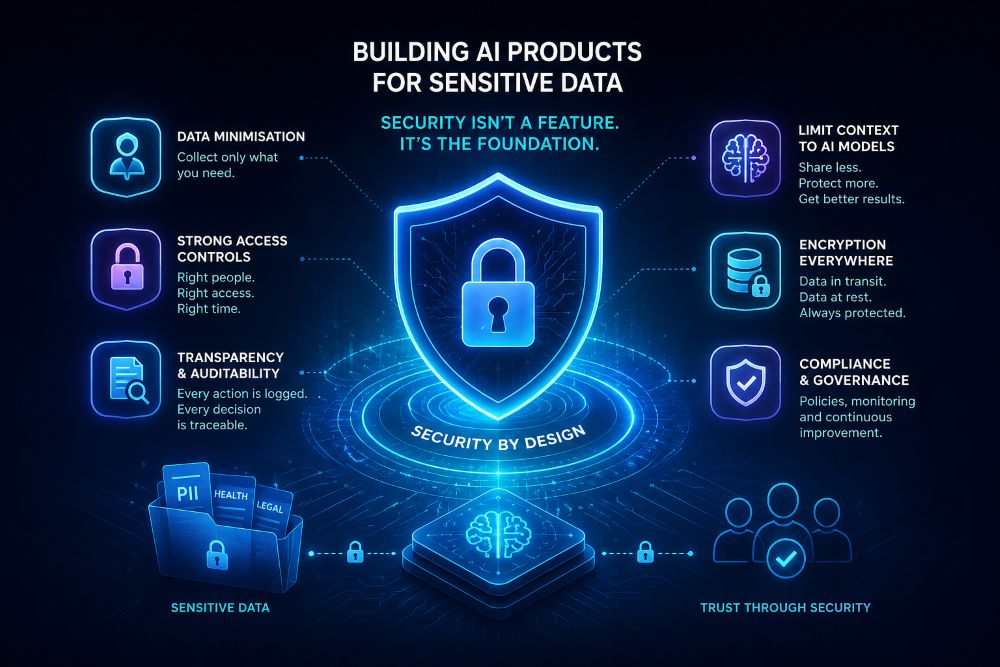
Artificial intelligence is making it easier than ever to build software that understands documents, assists users and automates complex workflows. But as organisations rush to integrate AI, one mistake appears repeatedly: treating security as something that can be added once the product is working. That approach might be inconvenient for a social media application. In industries handling personal, financial or legal information, it can be catastrophic.
Security isn't a checklist completed before launch. It's an architectural decision that influences every component of a system, from how data is collected to how AI models receive context and how audit trails are maintained. The earlier these decisions are made, the easier they are to implement correctly.
Collect only what you need
The simplest way to protect sensitive information is to avoid collecting unnecessary information in the first place. Every piece of personal data introduces additional risk and additional responsibility. Before storing anything, ask whether the application genuinely needs it to deliver value. Data minimisation reduces exposure while making compliance significantly easier.
Assume AI sees everything
One of the biggest design mistakes is sending excessive context to an AI model. Large language models perform better with relevant information, not necessarily more information. Applications should retrieve only the documents, records or fragments required to complete a task. This improves both privacy and response quality while reducing operational costs.
Every prompt sent to an AI service should be treated as part of your security boundary. Understand where it is processed, how long it may be retained and what contractual guarantees exist around data usage. Those questions should be answered before deployment, not after a customer asks.
Design for accountability
Users should never wonder why an AI made a recommendation or what information it accessed. Good systems record significant actions, preserve meaningful audit trails and clearly distinguish between AI-generated suggestions and human decisions. Transparency builds trust and dramatically simplifies troubleshooting when something goes wrong.
Security is layered
No single control is sufficient. Strong authentication, role-based authorisation, encryption, secure key management, monitoring and regular security testing all contribute to reducing risk. If one control fails, others should continue protecting the system. This layered approach has long been considered best practice and becomes even more important when AI is introduced into business workflows.
Trust is your competitive advantage
As AI becomes commonplace, the differentiator won't simply be which product has the most capable model. Customers will increasingly choose platforms they trust with their information. Organisations that design for privacy, minimise unnecessary data, implement strong governance and remain transparent about how AI is used will have a lasting competitive advantage. Features may attract users, but trust is what keeps them.

Share your thoughts