
Security Lessons from Building Software for Sensitive Information
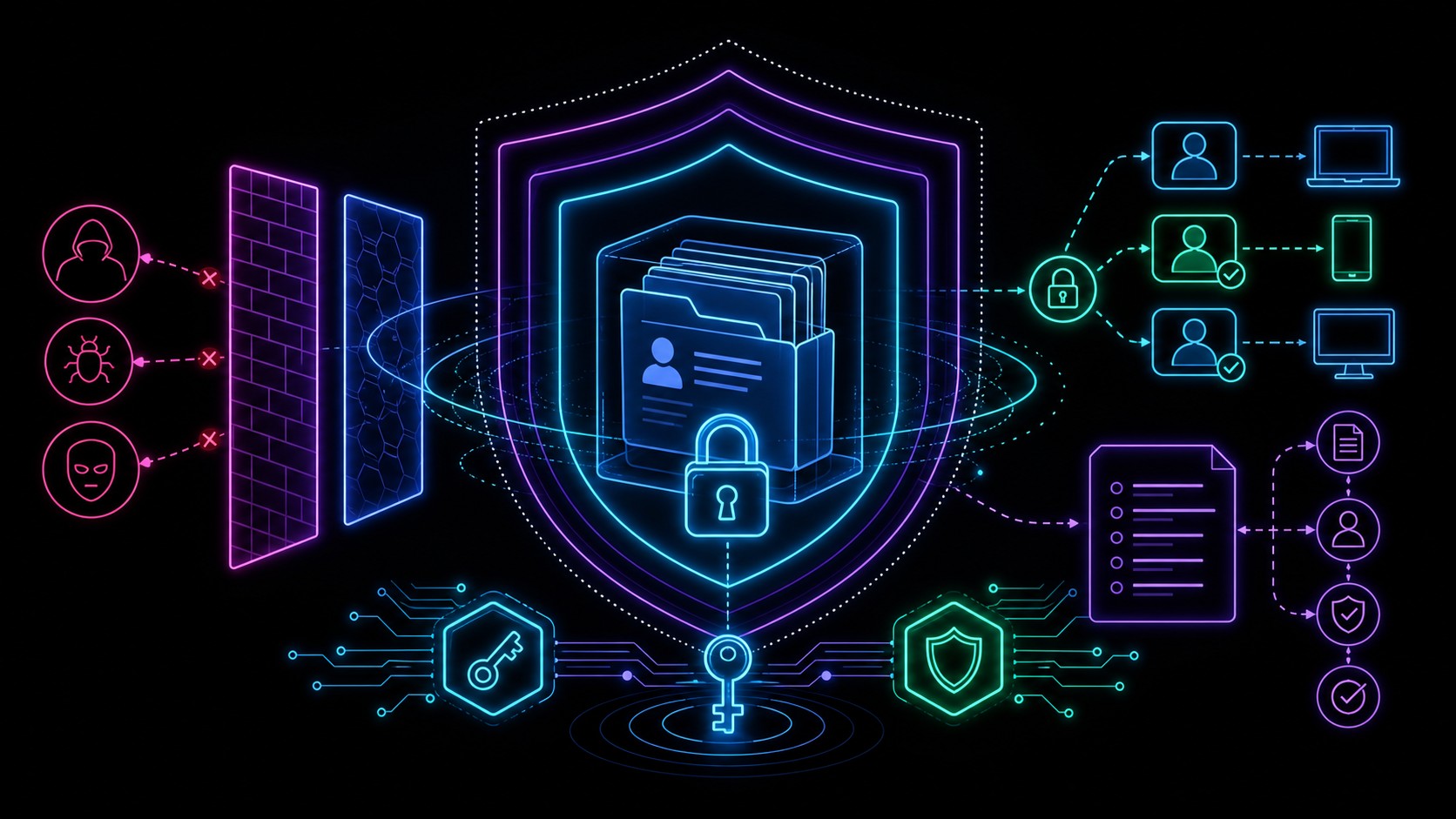
Applications that manage sensitive information have very little room for error. Whether the data relates to customers, healthcare, finance or legal matters, users expect their information to remain confidential, accurate and available only to the right people. Meeting those expectations requires far more than enabling HTTPS or adding a login screen. It requires designing security into every architectural decision from the very beginning.
One of the biggest lessons is that security is primarily about reducing trust. Every request, service and integration should receive only the minimum access required to perform its task. This principle of least privilege limits the impact of mistakes because even if one component is compromised, it cannot automatically access everything else. Small permission boundaries create resilient systems.
Authentication and authorisation deserve separate attention. Authentication confirms who or what is making a request. Authorisation determines whether that identity may perform a specific action on a specific resource. Blurring these responsibilities is one of the most common causes of data exposure. Every protected endpoint should verify both identity and permission before executing business logic.
Sensitive systems also benefit from explicit data ownership. Every piece of information should have a single source of truth and clearly defined boundaries around who can read, modify and export it. Multi-tenant applications should enforce tenant isolation on every request rather than relying on client-side assumptions or hidden interface elements.
Secrets management is another area where mature platforms differ. API keys, signing certificates, database passwords and encryption keys should never be embedded in source code or configuration files committed to version control. Centralised secret management, rotation policies and environment-specific configuration significantly reduce operational risk while simplifying deployment.
Audit logging is often viewed as a compliance requirement, but it is equally valuable for operational support. Recording who performed an action, when it occurred and why it happened provides the evidence needed to investigate incidents and explain unexpected behaviour. Good audit logs focus on meaningful business events rather than overwhelming teams with low-value technical noise.
Input validation extends well beyond preventing SQL injection. Every file upload, identifier, path and request payload should be treated as untrusted until validated. Strong validation protects downstream systems, improves data quality and prevents small mistakes from becoming security incidents. Consistent validation rules also make APIs easier to consume because behaviour is predictable.
Operational security continues long after deployment. Vulnerability assessments, penetration testing, dependency updates and automated security checks should become routine parts of delivery rather than one-off exercises. Security improves through continuous verification, not occasional reviews performed shortly before release.
Perhaps the most important lesson is recognising that security and usability are not opposing goals. Users appreciate systems that protect their information without creating unnecessary friction. Thoughtful authentication, meaningful error messages, clear permission models and predictable workflows produce software that is both safer and easier to use.
Building software for sensitive information changes the questions architects ask. Instead of asking whether a feature works, they ask who can access it, what happens if it fails and how its behaviour can be verified. That mindset leads to platforms that remain trustworthy as they evolve.
Security is not a checklist completed before production. It is an architectural discipline that influences every layer of a system. Teams that embrace security by design create applications that inspire confidence, withstand change and protect the people who depend on them every day.

Share your thoughts