
Why Request-Response APIs Eventually Need Events and Background Processing
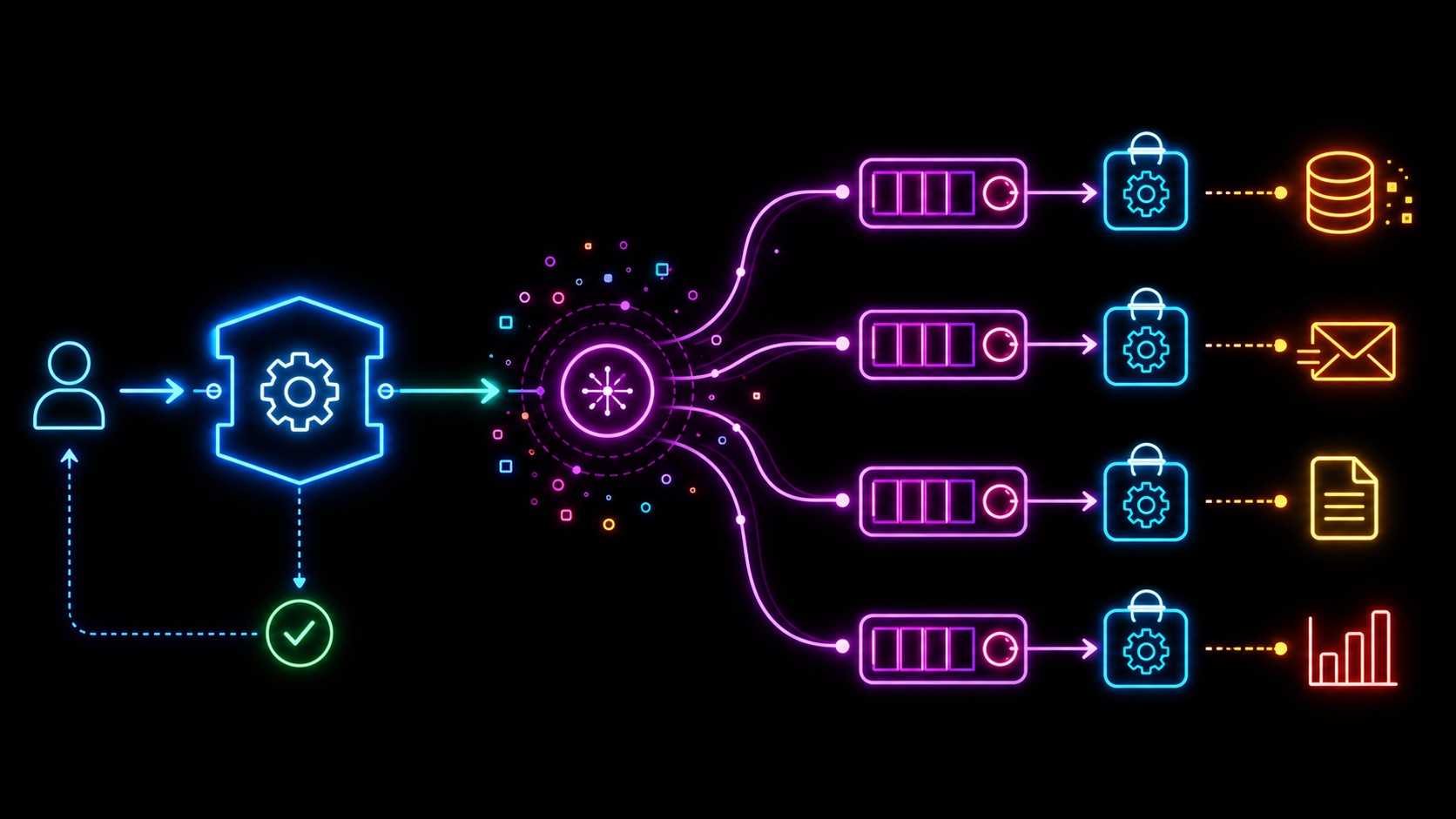
Most software platforms begin life with a simple request-response model. A client sends a request, the server performs some work and returns a result. This pattern is intuitive, easy to debug and ideal for many business operations. As systems grow, however, the amount of work triggered by a single request also grows. What was once a straightforward API call gradually becomes responsible for sending emails, updating search indexes, generating documents, synchronising external systems and producing audit records. At that point, request-response alone starts working against you.
The first warning sign is increasing response time. Users expect an application to acknowledge their action almost immediately, but every additional task performed synchronously extends the wait. A request that creates a record should not also spend several seconds generating reports, notifying downstream systems and uploading files before responding. Separating immediate work from follow-up work dramatically improves the user experience.
Background processing allows the API to complete only the work required to satisfy the user's request. Everything else becomes a queued task executed independently. Instead of waiting for multiple operations to complete, the client receives confirmation quickly while workers process secondary activities in the background. The application feels faster even though the same amount of work is still being performed.
Events take this idea one step further. Rather than directly calling every downstream service, the API publishes an event describing what happened. Other components subscribe to events that matter to them and react independently. A new order might trigger inventory updates, notifications, analytics and billing without the original API needing to understand every consumer. This reduces coupling and allows the platform to evolve without constantly modifying existing endpoints.
Another major advantage is resilience. External systems fail, networks become unreliable and downstream services occasionally experience outages. In a purely synchronous architecture, one unavailable dependency can cause the entire request to fail. Queue-based background processing provides a natural buffer. Work can be retried automatically, delayed until dependencies recover or redirected for manual intervention without affecting the original user interaction.
Events also encourage clearer service boundaries. Each service becomes responsible for a specific business capability instead of acting as a central coordinator for every workflow. Teams can develop, deploy and scale individual services more independently because communication happens through well-defined events rather than tightly coupled API calls.
This doesn't mean every API should immediately adopt event-driven architecture. Simplicity has enormous value, particularly during the early stages of a product. Introducing queues, workers and event brokers before they solve a real problem often increases operational complexity unnecessarily. Start with request-response where it makes sense, then introduce asynchronous processing as measurable bottlenecks appear.
Observability becomes even more important in distributed systems. Once work is spread across multiple queues and background workers, correlation identifiers, structured logging and end-to-end tracing become essential. Engineers need to understand how a single business action moves through the platform, even when it spans several independent services and minutes of processing time.
Designing asynchronous workflows also requires careful thinking about idempotency and retries. Messages may be delivered more than once, workers may restart and transient failures are inevitable. Every background task should be safe to retry without producing duplicate business outcomes. This principle is one of the foundations of reliable distributed systems.
Request-response APIs remain the backbone of most enterprise applications because they provide an excellent interface for user interactions. Events and background processing don't replace them—they complement them. By keeping user-facing requests fast while allowing the platform to perform additional work asynchronously, organisations can build systems that remain responsive, scalable and resilient as their business grows.

Share your thoughts